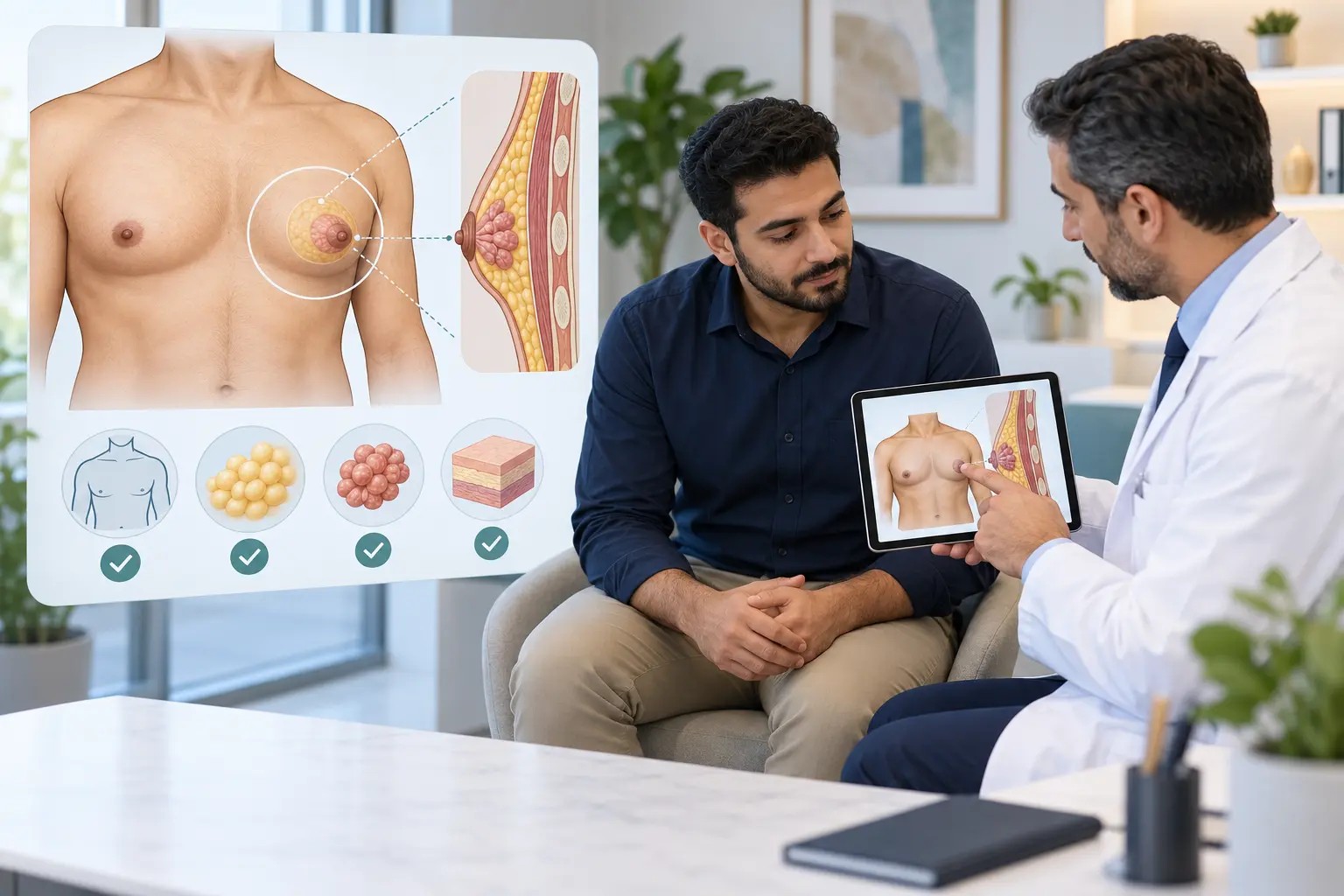
Searching for a surgeon is easier when “best” is translated into facts you can verify. Gynaecomastia surgery should begin with a sound diagnosis, not a promise about a device, a scar or a result. This guide explains what to check before choosing a surgeon in Cairo and how to recognize a situation that needs medical assessment before cosmetic planning.
For an overview of the operation itself, read the clinic's gynaecomastia surgery service guide. A short video on causes and treatment is also available.
First confirm what is causing the chest enlargement
True gynaecomastia is benign growth of male breast gland tissue. Lipomastia is enlargement mainly from fat, and the two can coexist. A proper consultation should ask when the change began, whether it is painful or one-sided, and about weight change, prescribed medicines, supplements, anabolic steroids, alcohol and recreational drugs. Examination should include the chest and, when indicated, a general and testicular assessment.
The European Academy of Andrology guideline recommends tailoring blood tests to the history and examination; possible tests include reproductive hormones, thyroid, liver and kidney tests and tumour markers. Imaging is used when the examination is uncertain, and a suspicious lesion needs diagnostic assessment rather than being treated as routine gynaecomastia. European Academy of Andrology clinical practice guideline
The American College of Radiology advises that routine breast imaging is usually unnecessary when the examination is typical for gynaecomastia or lipomastia. Imaging choice changes when there is an indeterminate mass or an examination suspicious for male breast cancer, and it also depends on age. ACR Appropriateness Criteria: Evaluation of the Symptomatic Male Breast
Match the operation to gland, fat and loose skin
There is no single operation that is right for every chest. Liposuction can address a fat-dominant component, direct excision can remove firm gland that liposuction cannot reliably remove, and skin reduction may be discussed when there is substantial excess skin. Some patients need a combination. The position of scars, the possibility of contour irregularity and the chance of revision should be explained for the proposed plan.
A responsible surgeon should also discuss non-operative steps first. When a medicine, substance or health condition may be contributing, the prescribing clinician and relevant specialist should guide any change; never stop prescribed treatment on your own. Surgery is generally considered after the diagnosis and reversible causes have been addressed, particularly when long-standing enlargement causes persistent physical or psychological distress.
Use objective criteria to compare surgeons
If your search began with “best breast surgeon in Cairo”, treat it as a prompt to compare independently checkable qualifications, relevant male-breast experience, a diagnosis-specific plan, licensed facilities, clear consent and reachable postoperative care—not as proof that any advertisement or individual is objectively superior.
Check the following before deciding:
Verifiable professional standing
Confirm current registration and a recognized surgical specialty qualification through the relevant official register. Ask who will perform each part of the operation and who provides anaesthesia. A title on a website is not a substitute for verification.
Relevant case experience
Ask how the surgeon assesses gland, fat and skin, which techniques they use for anatomy like yours, and how often they manage asymmetry, revision and complications. Numbers alone do not prove quality; the explanation should be specific and understandable.
An individualized plan
You should be told why liposuction, gland excision, skin reduction or a combination is proposed; where scars may lie; whether removed tissue will be examined; and what result is realistically achievable. Be cautious with “scarless,” “guaranteed” or universally superior-technique claims.
A safe facility and aftercare route
Confirm that the procedure will take place in an appropriately licensed or accredited facility with qualified anaesthesia, monitoring, infection-control processes and an escalation plan. Ask who answers urgent concerns after hours, where you would be examined, and how scheduled follow-up is arranged. These are also central themes in the American Society of Plastic Surgeons' surgeon-selection guidance.
Questions worth taking to the consultation
Ask: What confirms my diagnosis? Do I need imaging or laboratory tests? What proportion is gland, fat and loose skin? Why is this technique appropriate for me? Where will the scars be? What asymmetry may remain? What are the anaesthesia and clot risks in my health situation? What happens if I develop a haematoma, infection, fluid collection, nipple or skin-circulation problem, or contour irregularity? Who sees me urgently, and what is the revision policy?
Before-and-after photographs can help explain a surgeon's aesthetic approach, but only when the images are consented, unaltered and comparable. They cannot predict your result. Online ratings can reveal themes about communication or follow-up, but they do not establish diagnosis, technical competence or complication rates. Use them as one small input, not the deciding test.
Understand risks without turning statistics into a ranking
Recognized risks include bleeding or haematoma, seroma, infection, altered nipple or chest sensation, asymmetry, contour irregularity, scarring, persistent pain, wound-healing problems, blood clots, anaesthesia complications and possible revision. Your personal risk depends on the operation, health, nicotine exposure and other factors, so consent should be individualized. American Society of Plastic Surgeons: gynaecomastia surgery safety and risks
A retrospective study of 4,996 adult operations recorded at least one complication within 30 days in 4.4% of cases. Inpatient surgery, higher body-mass index, a history of sepsis and bleeding disorders were associated with higher risk. The database covers short-term recorded outcomes in a selected US surgical population; it cannot predict an individual's result or rank surgeons and clinics in Cairo. Knoedler and colleagues, primary cohort study
Prepare so the consultation is clinically useful
Bring a full list of medicines, vitamins, supplements and hormones; disclose anabolic-steroid and nicotine use honestly; and bring previous imaging or laboratory results. Write down when the enlargement started, whether it changed quickly, and any nipple discharge, testicular symptoms or family history of breast or testicular cancer. Ask for written instructions about medicines, nicotine, fasting, transport, garments, activity, wound care and emergency contact details.
You can review the clinic's professional team and verification links before an appointment. Those links help you check claims at their source; they are not a guarantee of a particular outcome.
When not to wait for a routine cosmetic consultation
Arrange prompt in-person assessment for a hard, fixed or off-centre one-sided lump; bloody nipple discharge; new nipple or skin retraction or ulceration; a new armpit lump; rapid unexplained enlargement; or a testicular lump, pain or swelling. These findings do not prove cancer, but they should not be labelled routine gynaecomastia without examination.
After surgery, rapidly expanding one-sided swelling, tightness, severe escalating pain or active bleeding can indicate a haematoma and needs immediate contact with the surgical team. Fever with spreading redness, pus, foul fluid or wound opening needs same-day assessment. A pale, blue, grey, black or unusually cold nipple or skin edge also needs immediate review. Call emergency services for sudden breathlessness, chest pain, coughing blood, fainting, collapse or uncontrolled bleeding.
The useful definition of “best”
The safest choice is not a name produced by a search result. It is a surgeon whose credentials can be verified, whose plan starts with the correct diagnosis, who can explain realistic options and complications, who operates in an appropriate facility, and whose team can provide timely follow-up. Compare consultations if you remain uncertain, and do not proceed until your questions are answered without pressure.
This article is for general education, not personal medical advice. It cannot diagnose chest enlargement, determine whether you need surgery or replace an in-person examination and an individualized discussion with a licensed clinician. Sources checked on 11 October 2026.