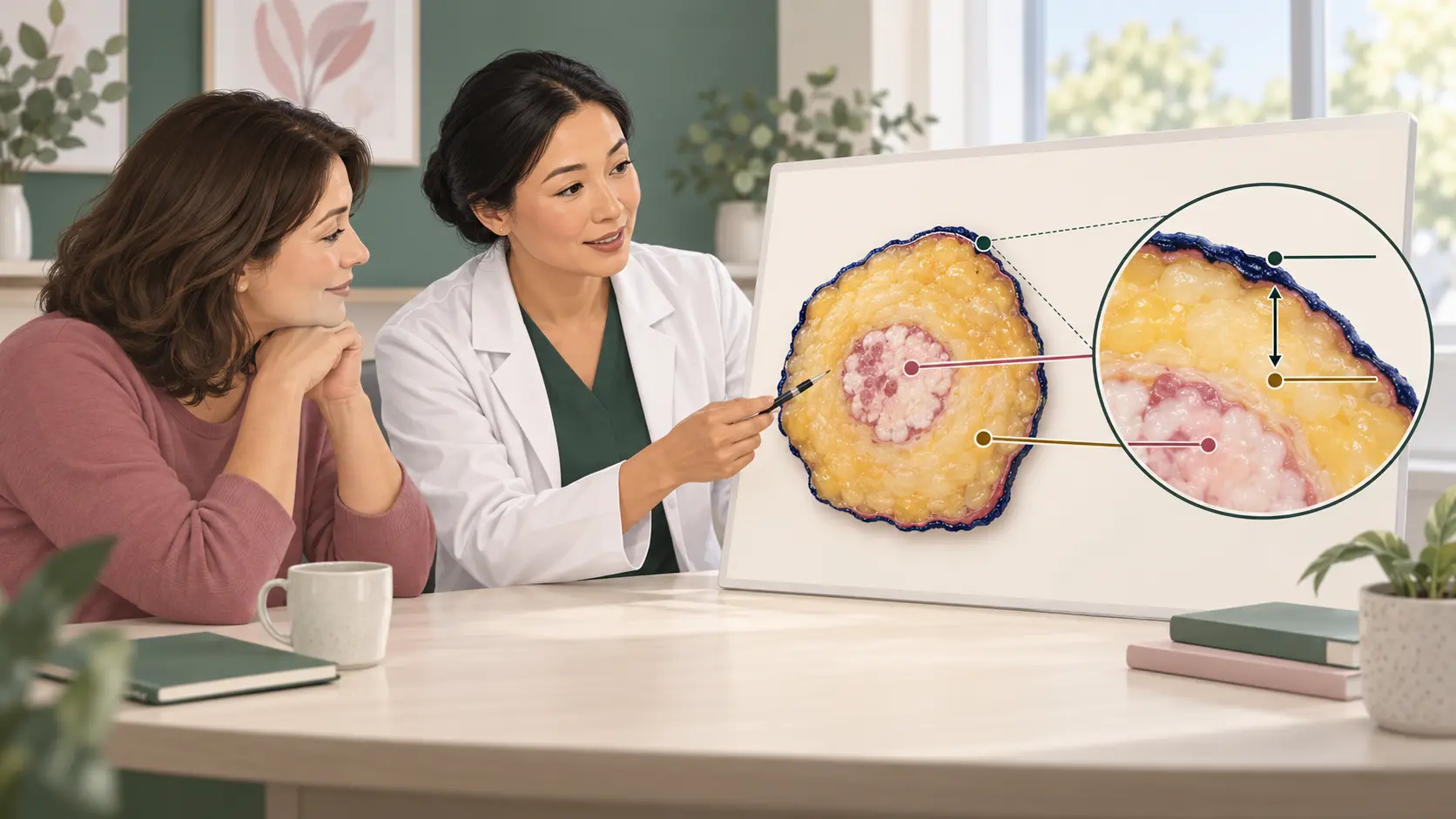
After a lumpectomy (wide local excision), the pathology report describes the tumour and the tissue around it. The margin result answers a specific question: do cancer cells reach the inked outer surface of the removed specimen? It does not by itself describe lymph-node status, distant spread or the whole treatment plan.
This guide expands on our introduction to breast-conserving surgery and explains the result you may hear as clear, close or positive.
What does the pathologist examine?
The surgical specimen is oriented so the team can identify its different surfaces. In the pathology laboratory, the outer surface is marked with ink, the tissue is sliced and representative sections are examined under a microscope. The report may name a particular direction—such as upper, lower, inner, outer, superficial or deep—and may record the measured distance between tumour and that edge. ASBrS 2024 margin guidance
Clear, close and positive are not interchangeable
Clear or negative
A negative margin means tumour is not present at the relevant inked edge. For stage I–II invasive breast cancer treated with breast-conserving surgery and whole-breast irradiation, the major consensus standard is “no ink on tumour”; routinely removing more tissue only to obtain a wider negative distance has not been shown to improve local control. SSO–ASTRO invasive-cancer guideline Supporting meta-analysis
Close
A close margin means tumour is near an edge but does not necessarily touch it. “Close” is not one universal diagnosis. Its importance depends on whether the finding is invasive cancer or pure ductal carcinoma in situ (DCIS), which margin is close, the planned radiation, the amount and distribution of disease, and other pathology details. A close result therefore does not automatically mean that the first operation failed.
Positive or involved
A positive margin means cancer cells reach the inked cut surface. This usually triggers a focused discussion about further local treatment, often re-excision of the affected margin. The correct next step is individual: the team considers the exact pathology, where and how extensively the margin is involved, what breast tissue remains, the likely cosmetic effect and the wider treatment plan. ASBrS 2024 margin guidance
Why do invasive cancer and DCIS use different standards?
For invasive cancer receiving whole-breast irradiation, “no ink on tumour” is the established adequate-margin standard. For pure DCIS treated with breast-conserving surgery and whole-breast irradiation, a 2 mm margin is the consensus standard associated with a lower risk of recurrence than smaller negative margins. A negative margin narrower than 2 mm is not, by itself, an indication for mastectomy; clinical judgement is used when deciding whether re-excision is worthwhile. SSO–ASTRO–ASCO DCIS guideline
When invasive cancer and DCIS are present in the same specimen, the applicable rule can differ from pure DCIS. These standards also have defined clinical settings: treatment after preoperative systemic therapy, partial-breast irradiation, mastectomy and unusual pathology may need a separate multidisciplinary decision. Do not compare a single number from your report with someone else’s result without this context. ASBrS 2024 margin guidance
Does a close or positive margin always mean another operation?
No. A close but negative margin may already be adequate in one setting and need discussion in another. A positive margin more commonly leads to re-excision, but the team may discuss different options when involvement is extensive, when another lumpectomy would remove too much breast tissue, or when the expected result would be poor. Mastectomy is not the automatic consequence of every close margin.
The decision is best made after the surgeon, pathologist, radiologist and oncology team have reviewed the result together. If further breast-conserving surgery is appropriate, oncoplastic techniques may sometimes help reshape the breast; see the clinic’s breast cancer surgery pathway.
Questions to ask at the results appointment
Ask: “Is my diagnosis invasive cancer, pure DCIS, or a mixture of both?”
Ask: “Which margin is involved or close, what is the measured distance, and is the finding focal or more extensive?”
Ask: “Does this result meet the margin standard for my planned radiation and treatment pathway?”
Ask: “If you recommend another operation, what would be removed, what are the alternatives, and how might each option affect breast shape and later treatment?”
Ask when the multidisciplinary discussion will occur, who will explain the final recommendation, and whom to contact if you do not receive the plan at the agreed time.
Choosing a surgeon for breast-conserving care
If you searched for “best breast surgeon in Cairo”, compare objective criteria rather than slogans: verifiable qualifications, experience in breast-conserving and oncoplastic surgery, access to reliable pathology and imaging review, multidisciplinary working and a clear plan for managing an involved margin. Read the clinic’s surgeon-selection criteria.
Evidence and scope
Sources were checked on 16 September 2026. This article explains common margin terminology after lumpectomy; it cannot interpret an individual pathology report or prescribe re-excision. The diagnosis, type of radiotherapy, earlier treatment and your priorities can change the recommendation. The six direct references and the safety guidance below define the evidence used.