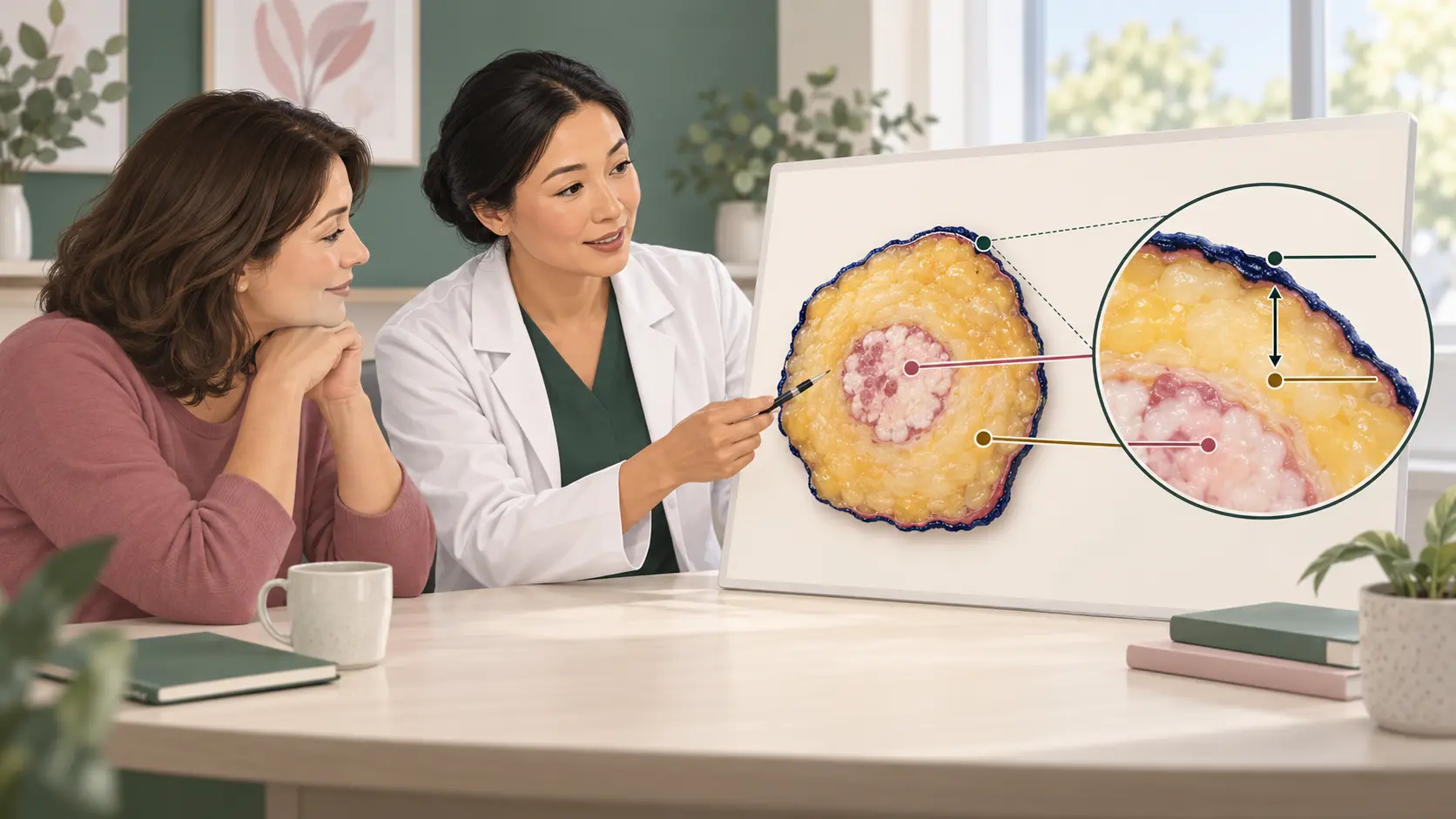
Breast skin can react to heat, friction, cosmetics, clothing, hormonal changes and infection just like skin elsewhere on the body. Most rashes and colour changes are not cancer. However, the breast, nipple and areola can also show important signs of disease, so a new change that persists, affects one side or progresses quickly should not be repeatedly self-treated without examination.
Common benign explanations
Eczema and contact dermatitis can cause itching, dryness, redness, scaling or weeping skin. New soap, perfume, detergent, fabric, adhesive or topical product may trigger it. Eczema often affects the areola or skin around the nipple and may occur on both sides or alongside eczema elsewhere.
Fungal or bacterial infection can cause soreness, redness, cracking or discharge, particularly with sweating, diabetes, skin folds, breastfeeding or a recent nipple injury. Mastitis usually causes a painful, hot, red area and may be associated with fever or flu-like symptoms. Psoriasis and other inflammatory skin conditions can also involve the breast.
Although these causes are common, a clinician should confirm the diagnosis when a change is unusual, one-sided, recurring or not settling with appropriate care.
Which skin changes need prompt assessment?
Book a breast appointment for a new or persistent change in the nipple, areola or breast skin, especially if it is unilateral. Warning signs include:
• a red, scaly, crusted, weeping or ulcerated change that starts on the nipple • bleeding, persistent burning or itching of the nipple • new nipple flattening, inversion or a change in direction • spontaneous discharge, particularly if clear or bloodstained • a breast or underarm lump • skin dimpling, puckering or tethering • a change in breast contour, size or shape • skin thickening with prominent pores that resembles orange peel • rapidly increasing redness, warmth, swelling or heaviness
These symptoms have many possible causes and do not diagnose cancer by themselves. They are a reason to be examined without unnecessary delay.
Paget disease of the nipple versus eczema
Paget disease of the nipple is rare and is associated with breast cancer in the tissue behind the nipple. It often appears as a red, scaly, eczema-like rash that begins on the nipple and may spread to the darker areola. The area may be sore, inflamed, itchy or burning and can crust, bleed or ulcerate.
Ordinary eczema is much more common, but appearance alone can be misleading. A persistent one-sided rash involving the nipple itself, particularly if it does not improve with correctly prescribed treatment, needs specialist assessment. Do not keep alternating steroid, antibiotic and antifungal creams without a diagnosis because temporary improvement can delay the appropriate investigation.
Rapid redness and orange-peel skin
Mastitis and an abscess commonly cause a hot, red, painful breast and may produce fever or illness, especially during breastfeeding. They need prompt medical care and sometimes antibiotics or drainage.
Rarely, rapidly developing redness, swelling, heaviness, skin thickening or an orange-peel appearance can be caused by inflammatory breast cancer. This type may not produce a distinct lump. The US National Cancer Institute advises medical evaluation because its symptoms can resemble infection. If symptoms fail to improve as expected after treatment for presumed infection, reassessment is essential.
What tests may be needed?
The breast specialist will ask when the change started, what treatments have been tried, and whether there is pain, discharge, fever, pregnancy, breastfeeding, a lump or previous breast disease. Both breasts, nipples and lymph nodes are examined.
Depending on the finding and age, assessment may include ultrasound, mammography or both. A swab may help if infection is suspected. A persistent suspicious nipple or skin lesion may require a small punch biopsy; a breast lump or imaging abnormality may require a needle biopsy.
When is it urgent?
Seek same-day medical advice for a rapidly spreading hot, painful, swollen breast with fever or feeling very unwell. Arrange prompt breast assessment for fast swelling or orange-peel skin even without fever, and for any persistent one-sided nipple rash, ulceration, bleeding, new inversion, spontaneous bloody discharge or associated lump.
The practical message
Most breast and nipple skin problems are treatable benign conditions. The safest approach is to know what is normal for you and have any new, one-sided, persistent or rapidly changing symptom examined. An early visit often provides reassurance and makes sure that less common but important conditions are not overlooked.
Sources reviewed
NHS Wales — Paget disease of the nipple: https://111.wales.nhs.uk/pagetsdiseaseofthenipple/
US National Cancer Institute — Inflammatory breast cancer: https://www.cancer.gov/types/breast/breast-cancer-types/inflammatory
NHS — Symptoms of breast cancer in women: https://www.nhs.uk/conditions/breast-cancer-in-women/symptoms-of-breast-cancer-in-women/