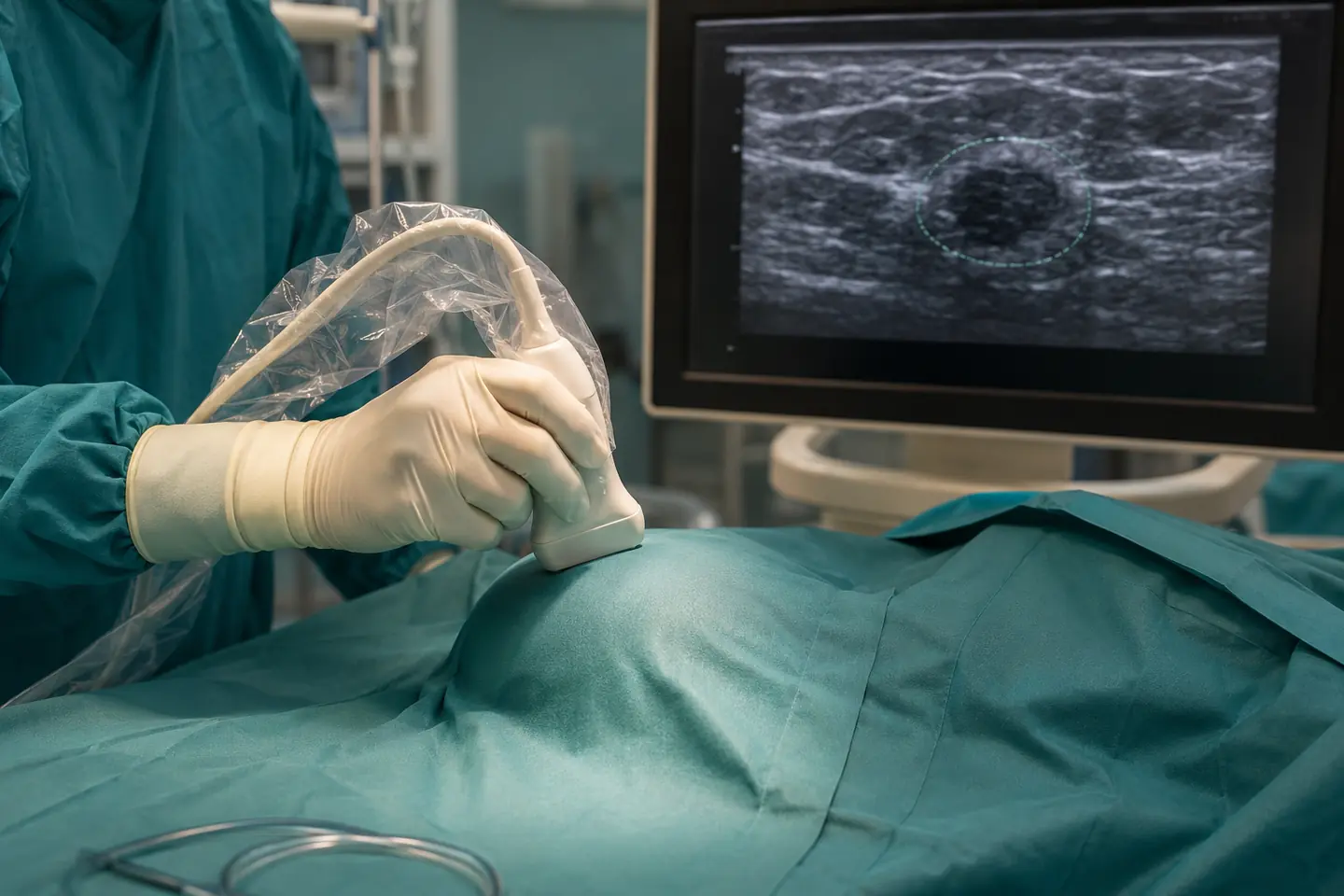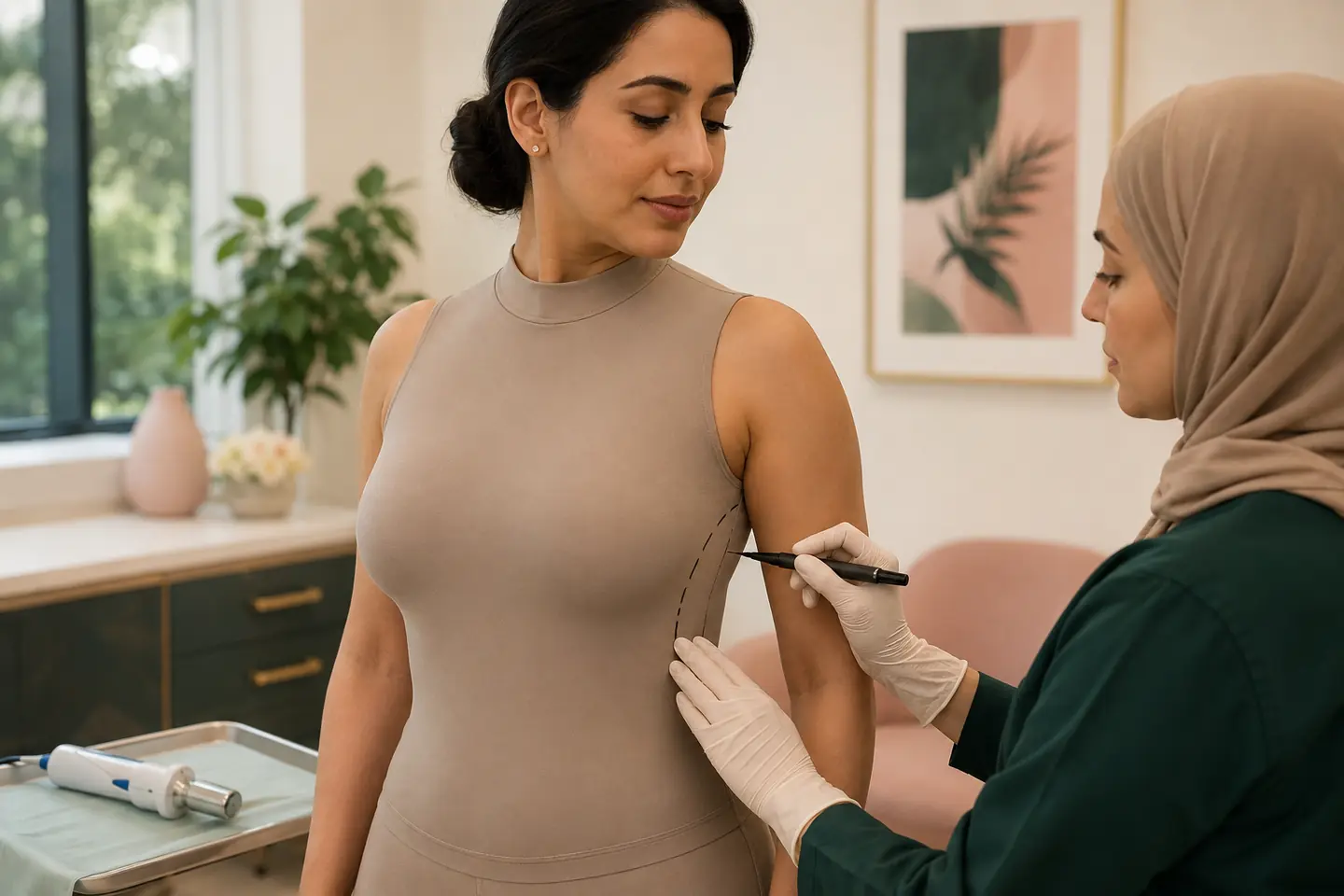
VASER is a form of ultrasound-assisted liposuction. A probe delivers ultrasonic energy into subcutaneous fat before suction, helping the surgeon contour selected areas. The treatment is sometimes promoted as “VASER breast lifting” because tissue contraction may accompany fat removal. The realistic effect depends on what is actually causing the breast to look low or loose.
What can VASER treat around the breast?
In selected patients, VASER-assisted liposuction can reduce local fat at the outer chest, bra roll, front of the armpit or lower chest and may improve definition around the breast. The healing response can produce some tightening of the treated skin. This may make the breast contour appear lighter or more defined when the problem is mainly superficial fat with mild laxity.
Treatment must remain in the correct tissue plane. Breast gland, implants, scars and lymphatic structures require careful consideration, particularly after cancer surgery or radiotherapy.
What is true breast ptosis?
Breast ptosis means the breast and often the nipple have descended because the skin envelope and internal support have stretched. Pregnancy, weight change, ageing, large breast volume and genetics contribute. Removing fat does not reliably move a low nipple or remove substantial excess skin.
A mastopexy reshapes the breast, removes or redistributes skin and raises the nipple–areola complex. It produces scars but remains the more predictable treatment for moderate or marked ptosis. An implant can restore volume but is not automatically a lift; a large implant in weak skin may increase future stretching.
Who might see a modest tightening effect?
The best candidate for VASER-assisted contouring has good general health, stable weight, localised fat, relatively elastic skin and only mild laxity. The nipple should not require a meaningful upward move. The patient must understand that the change is usually subtler than a surgical lift and develops during the months after treatment.
When the breast contains little local fat, when the skin is very thin, or when there is significant glandular droop, VASER may provide little benefit and could create irregularity. Examination and measurements determine whether the concern is fat, skin, gland position, implant position or a combination.
Is it scarless or painless?
VASER uses small access incisions rather than the longer scars of a mastopexy, but these openings can still leave marks. The procedure may be performed under local anaesthesia with sedation or general anaesthesia depending on extent and patient factors. No responsible surgeon can guarantee it is pain-free.
Recovery can include swelling, bruising, tenderness, numbness and use of a fitted support garment. Final contour takes time as swelling settles and tissues remodel.
Risks and limits of the evidence
Possible complications include seroma, burns, contour dents, asymmetry, prolonged swelling, altered sensation, infection, bleeding, pigmentation change, loose skin or the need for revision. Over-aggressive treatment near a thin breast envelope may reveal underlying structures or worsen irregularity.
Published evidence supports ultrasound-assisted liposuction for body contouring and describes skin retraction, but high-quality evidence specifically comparing VASER with mastopexy for female breast lifting is limited. It should not be presented as an equivalent replacement.
The planning decision
A breast-focused consultation compares VASER-assisted contouring with conventional liposuction, energy-based skin treatment, fat transfer, reduction, mastopexy or a combined procedure. Sometimes the safest recommendation is to avoid treatment. VASER can refine selected contours, but the correct operation is determined by anatomy—not by a device name.
Sources reviewed
PubMed — Retrospective study of VASER-assisted high-definition liposculpture and skin retraction: https://pubmed.ncbi.nlm.nih.gov/35896731/
Royal College of Surgeons of England — Professional standards for cosmetic surgery: https://www.rcseng.ac.uk/standards-and-research/standards-and-guidance/service-standards/cosmetic-surgery/professional-standards-for-cosmetic-surgery/