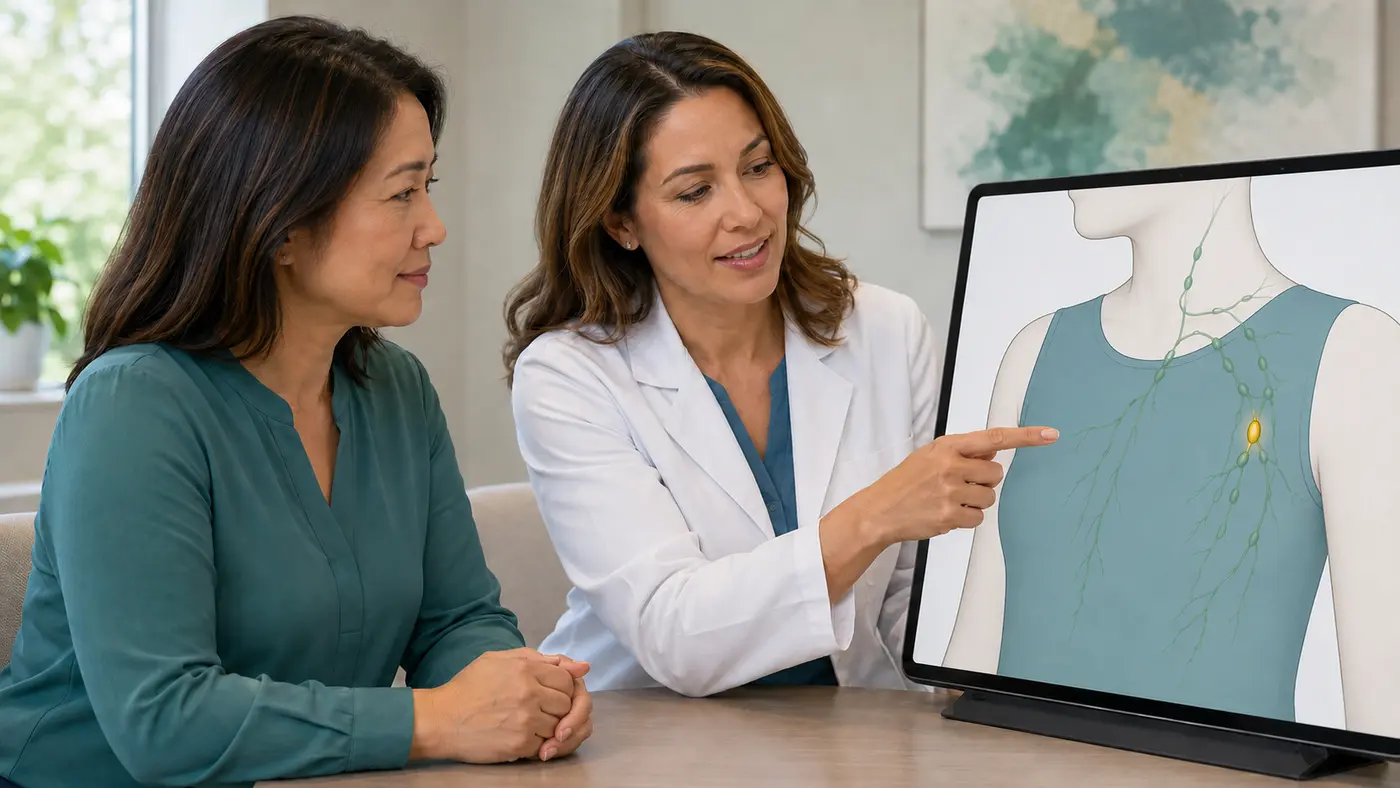
Being told that lymph nodes under the arm need checking can sound like a much larger operation than it usually is. A sentinel lymph-node biopsy (SLNB) is a targeted staging procedure: it identifies and removes the first node—or small group of nodes—most likely to receive lymph from the breast. A pathologist then examines the removed tissue for cancer cells. The tracer or dye maps the drainage route; it does not diagnose cancer on its own.
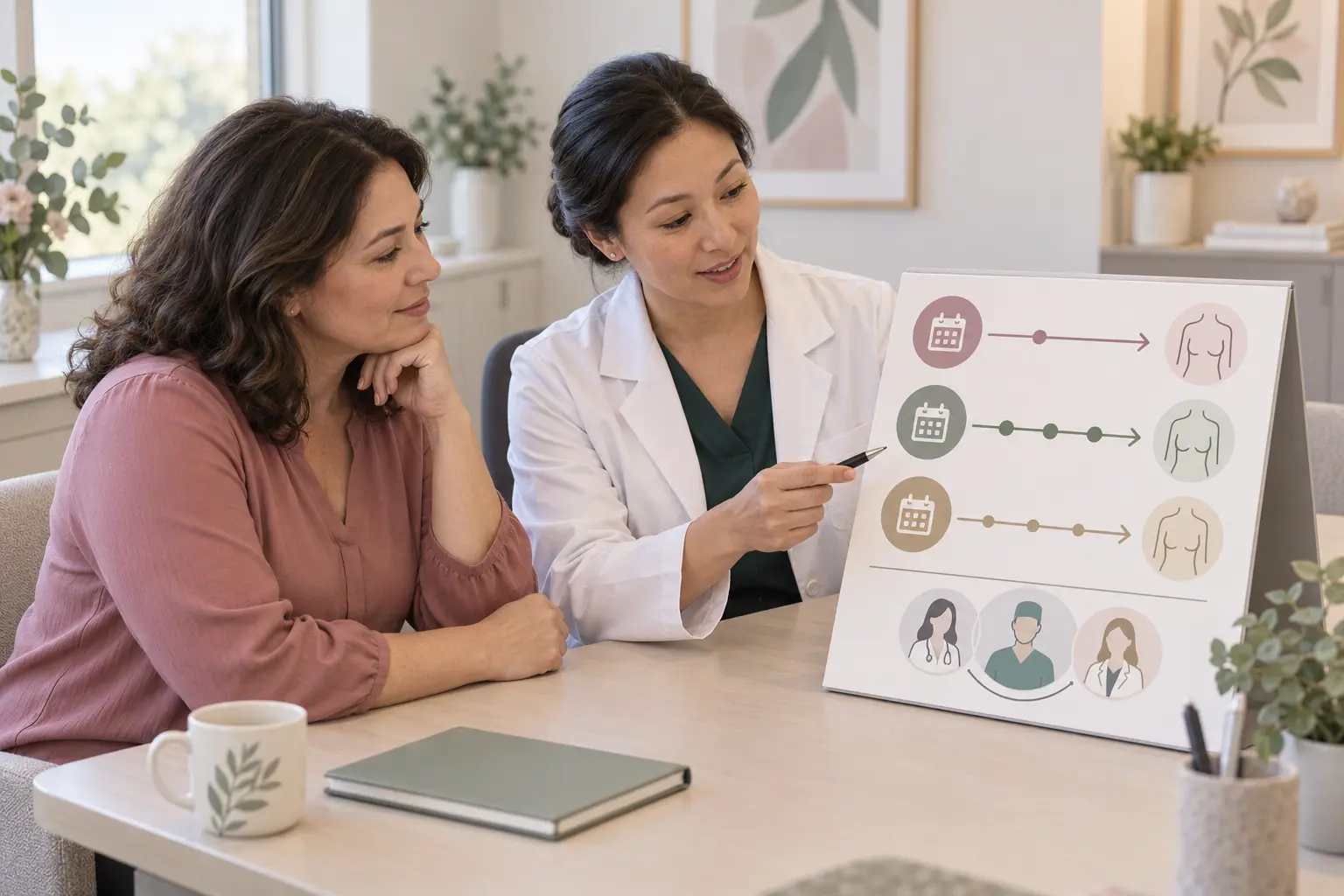
SLNB is different from an axillary lymph-node dissection, which removes more nodes. Whether the team recommends, omits or extends underarm surgery depends on the breast diagnosis, axillary imaging or needle-biopsy findings, tumour features, type of breast operation, and planned radiotherapy or systemic treatment. Read how this fits into the breast cancer surgery pathway.
What happens before and during the biopsy?
Before surgery, ultrasound is used to assess the axillary lymph nodes. If an abnormal node is seen, ultrasound-guided needle sampling may be recommended. When SLNB is planned, a small amount of radioactive tracer, blue dye or both is injected near the breast according to the local protocol. The material follows the lymphatic channels towards the first draining nodes.
During the operation, the surgeon uses a handheld detector and/or the blue colour to locate the sentinel node or nodes through a small underarm incision. The removed tissue goes to pathology. Mapping identifies where the nodes are; only microscopic examination determines whether they contain cancer cells. SLNB is commonly performed during the same anaesthetic as a lumpectomy or mastectomy. NICE recommends a dual technique using isotope and blue dye, although local protocols can differ.
Tell the team before the procedure if you are pregnant or may be pregnant, have a known dye or medicine allergy, or have had previous breast or axillary surgery, because these details can alter planning.
Who is usually offered sentinel-node biopsy?
Under NICE NG101, SLNB is used instead of full axillary clearance to stage invasive breast cancer when preoperative axillary ultrasound shows no lymph-node involvement, or when a suspicious node has been sampled and the needle biopsy is negative.
For ductal carcinoma in situ (DCIS), SLNB is not routinely performed with breast-conserving surgery unless the risk of hidden invasive cancer is considered high. It is offered when mastectomy is planned because later lymphatic mapping may be less reliable after the breast has been removed. Patients with proven nodal disease before surgery or those receiving drug treatment before surgery follow a different, individualised axillary pathway. See the separate guide to breast-conserving surgery.
Can some patients safely avoid sentinel-node biopsy?
Yes—but only carefully selected patients under a defined multidisciplinary plan. The 2025 ASCO guideline says clinicians should not routinely recommend SLNB for a specific group: postmenopausal patients aged 50 or older, with a negative preoperative axillary ultrasound, grade 1 or 2 hormone-receptor-positive and HER2-negative invasive cancer no larger than 2 cm, who will have breast-conserving therapy.
The INSEMA randomised trial supports de-escalation in a defined population. Among selected patients with clinically node-negative T1 or T2 invasive cancer having breast-conserving surgery, omitting axillary surgery was noninferior to SLNB for five-year invasive disease-free survival. Those who omitted surgery had less lymphoedema, better arm mobility and less pain with arm or shoulder movement. Most participants had small T1 cancers, so the result should not be applied broadly.
This does not mean that everyone aged over 50 or everyone with a small tumour should skip the procedure. Node information may still change radiotherapy or systemic-treatment decisions, and the criteria do not automatically apply to suspicious nodes, mastectomy, larger or multicentric tumours, DCIS, male breast cancer or treatment given before surgery.
What does a positive or negative result mean?
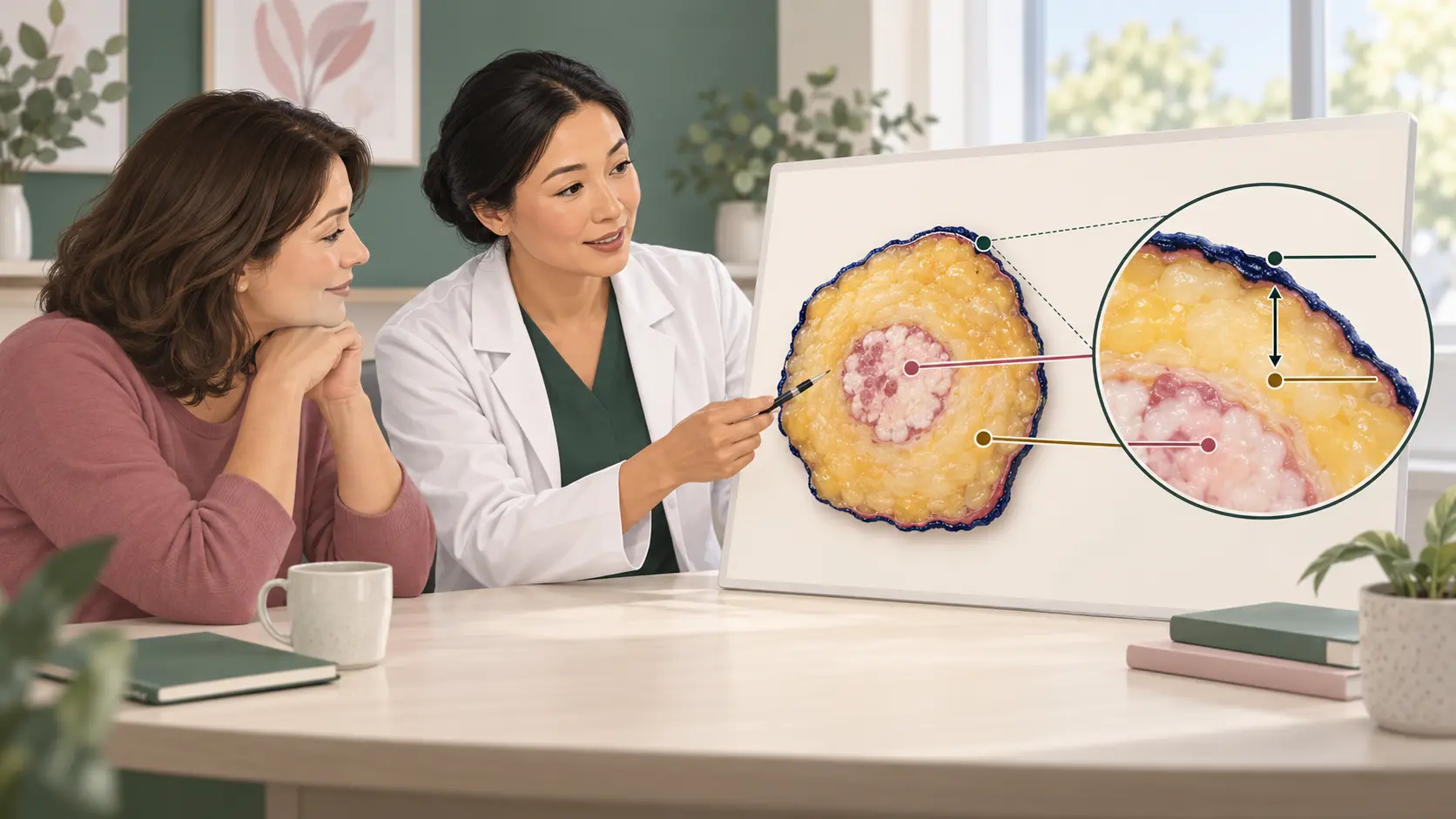
A negative result means cancer cells were not found in the examined sentinel nodes and usually avoids further axillary surgery. A positive result means cells were found in at least one sampled node. It does not by itself prove distant spread and does not automatically require removal of all remaining underarm nodes. The team considers whether the report shows isolated tumour cells, a micrometastasis or a macrometastasis, together with the number of involved nodes, breast operation, tumour biology, radiotherapy and drug-treatment plan.
ASCO advises against routine axillary dissection for early-stage patients with one or two positive sentinel nodes who will receive breast-conserving surgery and whole-breast radiotherapy. It also allows selected clinically node-negative patients with tumours up to 5 cm who have a mastectomy and one or two positive sentinel nodes to receive regional nodal radiotherapy and omit axillary dissection.
The SENOMAC randomised trial found that omitting completion axillary dissection was noninferior for five-year recurrence-free survival in selected clinically node-negative patients with one or two sentinel-node macrometastases; most participants received nodal radiotherapy. These results depend on eligibility and accompanying treatment, so the pathology result must be interpreted by the multidisciplinary team rather than as a stand-alone rule.
What effects can be expected after the operation?
A small underarm wound can cause temporary soreness, bruising, numbness, tingling or reduced shoulder movement. A seroma, wound infection or arm swelling can occur. The risk of lymphoedema is lower than after removing many axillary nodes, but it is not zero. Follow the written wound and movement instructions and read the guides to breast-surgery wound healing and early lymphoedema signs.
If blue dye was used, urine may appear blue or green for one or two days, and the breast skin can remain stained for weeks or months before fading. A blue-dye allergy is uncommon and is usually recognised and treated around the time of surgery. Blue-green urine alone can be an expected dye effect when you otherwise feel well; breathing difficulty, wheeze, widespread hives, or swelling of the face or tongue is not.
When should you seek urgent in-person care?
Contact the surgical team the same day for increasing or rapidly developing breast or armpit swelling, severe or worsening pain, active wound leakage, wound opening, spreading redness or heat, cloudy or foul-smelling fluid, fever, chills, or feeling acutely unwell. New persistent arm or hand swelling, heaviness, tightness or reduced movement also needs early assessment.
Call emergency services for uncontrolled bleeding, a rapidly expanding tense swelling, fainting or collapse, sudden breathlessness, chest pain, coughing blood, or severe allergic symptoms such as facial or tongue swelling, wheeze or difficulty breathing. Do not wait for an online reply when symptoms are severe or progressing quickly.
Questions to ask before consenting
- Why is SLNB recommended in my case, and would the result change radiotherapy or drug treatment? - Is my axillary ultrasound reassuring, or does any node need needle sampling first? - Which mapping method will be used, and what happens if no sentinel node is found? - If the node contains cancer cells, which options could apply to me: observation, radiotherapy or further surgery? - Who should I contact after discharge for swelling, wound problems or arm symptoms?
Choosing the surgical pathway
If you search for the best breast surgeon in Cairo, compare objective factors: breast-specific training, appropriate axillary imaging, a documented multidisciplinary plan, a clear explanation of whether the node result will change treatment, lymphoedema counselling, pathology review and reliable postoperative access. A promotional ranking cannot answer these questions.
References reviewed
American Society of Clinical Oncology — 2025 Sentinel Lymph Node Biopsy Guideline Update: https://doi.org/10.1200/JCO-25-00099
NICE NG101 — Early and locally advanced breast cancer, axillary surgery recommendations: https://www.nice.org.uk/guidance/ng101/chapter/Recommendations
US National Cancer Institute — Sentinel Lymph Node Biopsy fact sheet: https://www.cancer.gov/about-cancer/diagnosis-staging/staging/sentinel-node-biopsy-fact-sheet
Reimer et al. — INSEMA randomised trial: https://doi.org/10.1056/NEJMoa2412063
de Boniface et al. — SENOMAC randomised trial: https://doi.org/10.1056/NEJMoa2313487
Guy’s and St Thomas’ NHS Foundation Trust — Sentinel lymph-node biopsy patient guide: https://www.guysandstthomas.nhs.uk/health-information/sentinel-lymph-node-biopsy-breast-cancer
This article is for general education only. It does not diagnose a condition, replace an in-person examination, or substitute for the advice of your breast multidisciplinary team. The need for sentinel-node biopsy and any treatment after the result are individual decisions. If symptoms are severe or rapidly worsening, seek licensed urgent medical care rather than waiting for an online reply.